

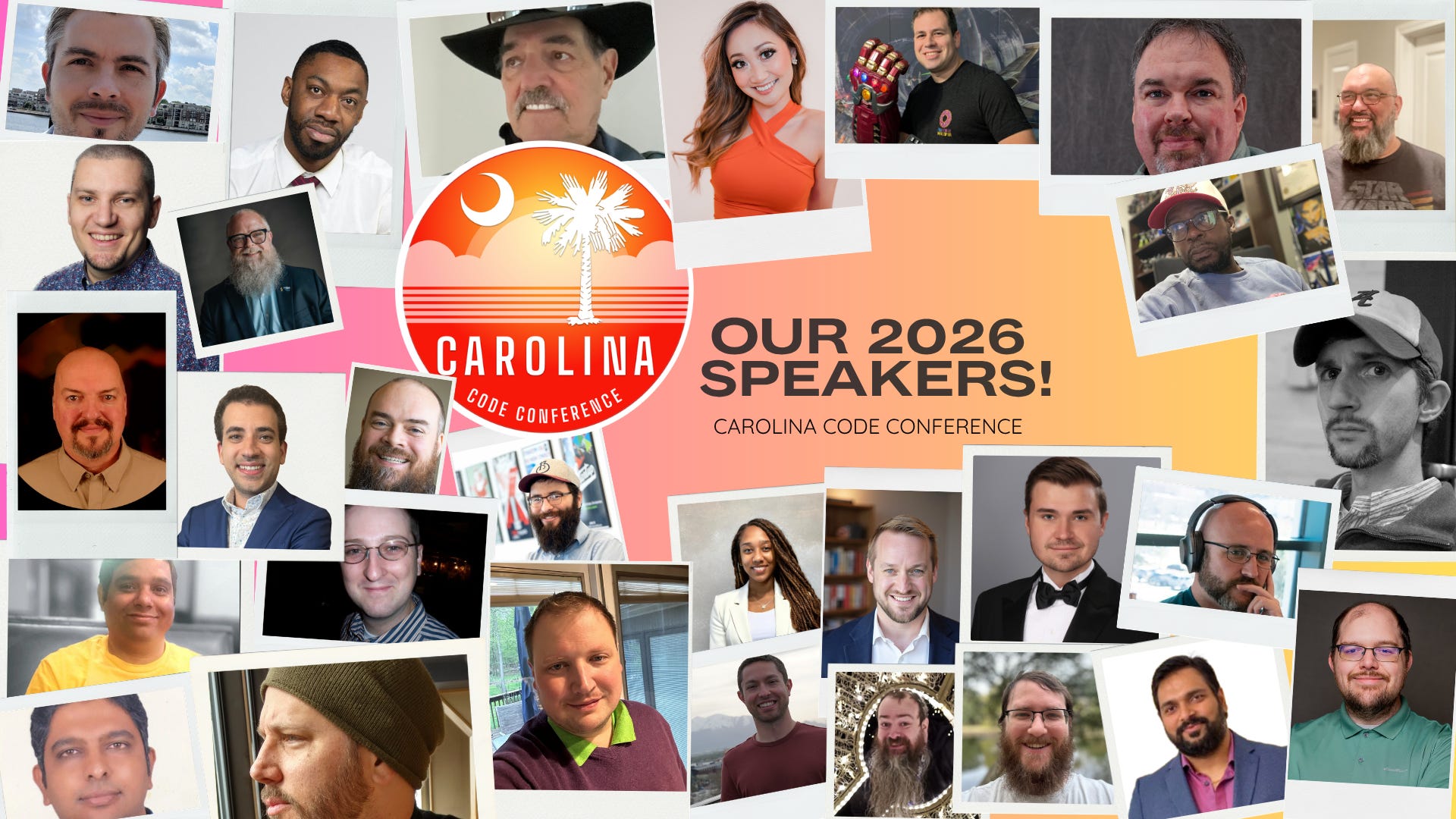
In previous years, we’ve somewhat intentionally tried to balance the AI related topics for talks just as we do with every topic. Balance is important, after all. The influence on our entire industry is more pronounced and that includes our talks this year! We had yet another very competitive year with 175 talks submitted.
Announced on [ LinkedIn | X | Instagram | YouTube ]
We have an incredible lineup this leading off with 4 great keynotes! After 3 years of pestering recruiting we are thrilled to welcome Craig Kerstiens to spread the good news of PostgreSQL! The magnificent Diana Pham will be returning for the 3rd year in a row, this time as a keynote, to take us for a walk with her robot dog! Houston Haynes will be making the debut of a brand new language in Clef! Closing out the conference, the legendary Trey Grainger will transport us with Wormhole Vectors!
Beyond the keynotes, we have an additional 14 Intermediate talks covering topics from Type Driven Design, Elixir & AI, Batch Observability with Java, Training AI to ride a Pony, Computer Vision, Etherhiding Cyberthreats, programming with Julia, Mutator Testing, real world COBOL, Micro VM’s and Unikernels, Intelligent Incident Response System and the meta topic, coding C# with C#.
Rounding things out we have 11 insightful lightning talks covering a wide array of topics including an OpenLDAP Directory Overview, Protobuf Reconsideration, KEDA Event Autoscaling, Security Developer Collaboration, Vibe Coding SaaS, Keycloak Identity Integration, AI Agent Tooling Evaluation, Edge AI IoT in Ruby, YAML Open Source Moat, Career Mentorship Strategies, and AI Product Management.
Check out all the details below!
Quick Notes
Memorial Day Discount!
Since we’re a little behind schedule getting this announcement out and it is Memorial Day, we’re offering a special Memorial Day promotion! For the rest of May, you can use the discount code HONOR250 for 20% off the conference ticket price!
We need your help with our Lyrical Code T-shirt!
We’ve been Rickrolled! Rick Astley’s “Never Gonna Give You Up” was voted as the song for this year’s Lyrical Code T-shirt! Visit our Github repo to submit a verse or the entire song as code in your favorite language. You can enter as little as a single verse or a the entire song but give it a try; it doesn’t take long and it’s a lot of fun.
We’ll combine lines in different languages to make our polyglot t-shirt that you can’t help but sing when you read. Don’t give me up…don’t let me down…don’t run around…and hurt me…
Your 2026 Carolina Code Conference Speakers!
Keep scrolling for full profiles and session overviews.
// Friday Talks
WITH friday_talks AS ( -- PostgreSQL w/ CTE
    SELECT speaker, title, format, scheduled_at
    FROM talks
    WHERE DATE(scheduled_at) = '2026-08-14'
)
SELECT * FROM friday_talks ORDER BY scheduled_at;
morning.summary()
9:00am // Craig Kerstiens - Postgres say what? #keynote
10:00am // Cameron Presley - Preventing Bugs with Better Types - An Intro to Type Driven Design #intermediate
10:30am // Gregory Noe - A Look at OpenLDAP - The Directory Database #lightning
10:45am // Paul Sullivan - Elixir & AI: Coding at Ludicrous Speed #intermediate
11:15am // AJ Danelz - It Is Time to Reconsider Protobuf #lightning
11:30am // Amit Kulkarni & Yamank Vashishtha - Proactive Batch Observability: Automate File Freshness and SLA Monitoring #intermediate
12:00pm // Redvers Davies - My Little Claude: Codegen Isn’t Magic #intermediate
afternoon.summary()
1:30pm // Jack Teitel - From Pixels to Patterns: A Pragmatist’s Guide to Computer Vision #intermediate
2:00pm // Aaron Augustine - Event-Driven Autoscaling with Kubernetes and KEDA: Practical Strategies for Modern Applications #lightning
2:15pm // Amon Otis Poston - Indelible Malware: Etherhiding and the future of Cyberthreats #intermediate
2:45pm // BREAK
3:00pm // Adam Anderson - From Prompt to Product: Building an SaaS company in the world of Vibe Coding #intermediate
3:30pm // Neviar Rawlinson - When Security Says “High Risk” and Developers Say “But That’s How It’s Supposed to Work” #lightning
3:45pm // Diana Pham - Taking Your Robot Dog Off the Leash with APIs #keynote
// Saturday Talks
query { # GraphQL
  saturdayTalks: talks(
    where: { scheduled_at: { _eq: "2026-08-15" } }
    order_by: { scheduled_at: asc }
  ) {
    speaker, title, format, scheduled_at
  }
}
morning.summary()
9:00am // Houston Haynes - The Clef Programming Language - A Ship of Theseus Story #keynote
10:00am // David Mackey - What the Mutant? Using Mutator Testing to Write Better Tests #intermediate
10:30am // Benjamin Overcash - Integrating Keycloak #lightning
10:45am // Paul Jarrett - Writing Open Source Ada in 2026 #intermediate
11:15am // Schuster Braun - Evaluating AI Agent Tooling #lightning
11:30am // Marty Heyman - COBOL - Round 2 #intermediate
12:00pm // Gene Gotimer - Bad Things You Can Do to Unsecured Containers #intermediate
afternoon.summary()
1:30pm // Tyler Benfield - Micro VMs and Unikernels: The Cloud’s Next Infrastructure Evolution #intermediate
2:00pm // Doug Cone - The Moat Was Made of YAML #intermediate
2:30pm // Joshua Ballanco - Julia: The Best Programming Language You’ve Never Heard Of #intermediate
3:00pm // Eugene Willis - 3 Mentors #lightning
3:15pm // AL Rodriguez - Coding C# with C# #intermediate
3:45pm // Trey Grainger - Beyond Hybrid Search with “Wormhole Vectors” #keynote
// Full Profiles

Craig Kerstiens |> Albany, CA
Postgres @ Snowflake
Social: [ @craigkerstiens, LinkedIn, Blog, Crunchydata ]
Craig was an early part of the team at Heroku, has helped scale developer focused companies. Craig has built teams and products at Citus Data, Microsoft, Crunchy Data, and now Snowflake. Regularly writes about startups and dev tools companies.
Keynote // Postgres say what?
Category: [ Development, Other ]
Languages: [ Postgres ]
Framework/Platform: [ Postgres ]
We all love Postgres, or so we say. But can we defend it, do we know why we love Postgres?
We’ll cover a rapid fire set of what makes Postgres great. Intermixed with a lot of things you had no idea Postgres could do.
Some examples of things we’ll cover.
psql is the Postgres CLI. But don’t you want a more advanced graphical editor? Not when you realize all it can do.
What if I told you I could do a health check on your database in 5-10 minutes–asking you nothing about your app and find easy wins for performance improvement? Every Postgres database has this information to pull it off and you don’t have to be a DBA or Postgres to to take advantage.
What about watching a movie from within Postgres? Does that make any sense at all? And while watching a movie from within Postgres may not help you with your production database, engineering at times should be fun so we’ll end with a little bit of it.

Cameron Presley |> Charlotte, NC
Owner of Small Batch Solutions - Professional Problem Solver
Social: [ @pcameronpresley, LinkedIn, Blog, Smallbatchsolutions, Sessionize ]
Cameron Presley is owner of Small Batch Solutions, a speaker, and a Microsoft MVP in Developer Technologies.
Based out of Charlotte, North Carolina, Cameron has ten years of experience working with start-ups and large enterprise both publicly and privately held to architect solutions, implement solutions, and training developers to be better today than what they were yesterday!
In his spare time, Cameron can be found hanging out with his family, playing board games, jamming on the bass guitar, and reading books.
Intermediate // Preventing Bugs with Better Types - An Intro to Type Driven Design
Category: [ Development ]
Languages: [ Typescript ]
Have you ever shipped a logic error to production? What about writing code that allowed you to do something that violated business rules? Wouldn’t it have been nice if the code itself prevented you from doing the wrong thing?
By leveraging key concepts from Functional Programming, I’ll show you how you can design your business domain such that your code can’t get into a bad state (or at the very least, without jumping through some hoops).
Intended for those with C# or TypeScript, I’ll demonstrate concepts like sum types/product types for better data modeling and design patterns like Option/Result to handle when things can go wrong while we build out the game of Blackjack.

Gregory Noe |> Grand Junction, CO
LDAP Support Team Lead - Symas Corporation
Social: [ LinkedIn, Symas ]
A support engineer since 2014, I specialize in OpenLDAP deployments and directory service migrations. As support team lead at Symas on OpenLDAP solutions, I work closely with organizations to design, implement, and maintain robust directory infrastructures. My expertise includes migrating legacy systems such as ODSEE and Sun ONE to modern OpenLDAP environments, helping teams improve performance, reliability, and scalability.
In my free time, I enjoy falling off mountain bikes in north central Washington State and British Columbia.
Lightning // A Look at OpenLDAP - The Directory Database
Category: [ Security ]
Languages: [ C ]
This talk will be a relatively high level overview of Directory Databases (LDAP as defined in RFC 4000 and friends). Directory Services was an international effort in the 1980s but was designed for mainframes and X400. The Internet made a lot of that obsolete so a “Lightweight” version of the Diectory Access protocol was created: LDAP. The original work was done at the University of Michigan and that implementation languished until 1999 when the OpenLDAP project was formed.
It will talk about the unique data organization and interface and discuss topics like normal use-cases, abnormal use-cases, integrating with other software applications, security, and performance.

Paul Sullivan |> Greenville, SC
Elixir advocate. 10 years in. Still not bored.
Social: [ LinkedIn, Thoroughcare ]
Paul Sullivan is a Senior Software Engineer at ThoroughCare, a Pittsburgh-based company, living in Greer, South Carolina. A polyglot developer who has worked across many languages and stacks, he found Elixir ten years ago professionally and never looked back. When he’s not writing Elixir, he’s spending time with his family or playing guitar.
Intermediate // Elixir & AI: Coding at Ludicrous Speed
Category: [ Development, Artificial Intelligence / Machine Learning ]
Languages: [ Elixir ]
Framework/Platform: [ Phoenix, LIveView, BEAM, OTP ]
A recent industry study benchmarked AI coding models across 20 programming languages. Elixir came out on top — 97.5% of problems solved, the highest of any language tested. Higher than Python, TypeScript, Go, and Rust. If you’ve never written a line of Elixir, that number probably surprises you.
We’ll dig into why Elixir is so uniquely productive with AI and it comes down to the language itself. Immutability means no hidden state for a model to trace. The pipe operator makes data flow explicit and readable, step by step. Pattern matching means every case is declared upfront — no nested conditionals, no hidden branches, no ambiguity. First-class documentation with verified examples gives AI models clean, correct training signal. A stable ecosystem with a decade of backwards compatibility means no conflicting patterns to confuse generation. LiveView brings real-time interactivity to the server without the complexity of a JavaScript framework, less surface area for an AI to get wrong. These aren’t accidents, they’re deliberate design choices that happen to make Elixir exceptional for AI-assisted development.
We’ll explore what makes Elixir so uniquely productive with AI through concrete examples that require no prior Elixir experience. No live coding. No Elixir evangelism. Just a surprising result from real research, and a satisfying explanation for why it happened.

AJ Danelz |> Greenville, SC
Cloud-Native | Streaming | Full-Stack Dev @ Rygen
Social: [ Blog, Rygen, Sessionize ]
I am a full-stack engineer, passionate about cloud application design and Event-driven architecture. I sometimes go outdoors for Disc golf, hiking, camping, or scuba diving. I consider myself a tinkerer, mixologist, and occasionally come up with good ideas that I write down.
Lightning // It Is Time to Reconsider Protobuf
Category: [ Development, Operations, Team Process & Management, Product ]
Languages: [ Any language Protobufs can compile to ]
Framework/Platform: [ buf.build ]
Protobuf adoption remains low despite years of maturity, but not for the reasons most developers think. The real barrier is not complexity or tooling; it is that most developers have only ever worked with JSON and never had a reason to choose something different. Protobuf does not ask you to compete with JSON on its home turf. It asks you to think about your interfaces differently.
The real case for Protobuf isn’t serialization speed. It’s contract-first development. One .proto file drives type generation across every language in your stack, schema drift becomes a lint error, and breaking changes get caught before they ship. Modern tooling (buf, ConnectRPC, protovalidate) has removed every historical friction point. This talk covers the practical path to adopting Protobuf without abandoning REST or JSON where they already work.
The tooling story has changed significantly. buf handles linting, formatting, and breaking change detection in CI. ConnectRPC works over plain HTTP without a proxy. protovalidate puts validation rules directly in the schema. Postman, VS Code, and IntelliJ all have native support.

Amit Kulkarni |> Tampa, FL
Michelin NA Site Reliability Engineer
Social: [ LinkedIn, Michelinmedia, Sessionize ]
Amit is a Site Reliability Engineer specializing in enterprise observability and distributed systems reliability at Michelin North America. He designs and implements reliability frameworks for business-critical data pipelines, with a focus on bringing SRE principles to batch processing environments.
At Michelin, Amit pioneered the organization’s latency-based SLO governance framework, protecting over $2 billion in invoice revenue through proactive monitoring and automated incident detection. His work on data freshness as a reliability signal represents a novel approach to batch system observability, enabling end-to-end visibility across multi-stage enterprise workflows. His research on enterprise observability patterns has been productionized across multiple business domains at Michelin and shared with international teams. He holds expertise in Splunk, distributed systems monitoring, SLI/SLO frameworks, and reliability engineering methodologies.

Yamank Vashishtha
Michelin NA Lead Software Engineer
Social: [ @VYamank, LinkedIn ]
Yamank Vashishtha is an experienced Mainframe Technology professional with over 18 years of expertise in COBOL, IDMS, IMS, CICS, and DB2 across complex enterprise environments. He has led modernization and migration initiatives, including transitioning legacy IDMS applications to DB2 and CICS while guiding offshore teams to deliver scalable solutions. Throughout his career at Syntel, Nityo Infotech, and CGI, he has specialized in system analysis, data processing, cross‑platform integrations, and ITIL‑aligned service delivery. In his current role as Senior Consultant at CGI Technologies & Solutions, he develops and maintains core mainframe components, supports multi‑LPAR operations, builds automation utilities, and collaborates closely with business teams to enhance system performance. Yamank is recognized for his technical depth, leadership, and commitment to operational excellence in mission‑critical environments.
Intermediate // Proactive Batch Observability: Automate File Freshness and SLA Monitoring
Category: [ Operations, DevOps ]
Languages: [ Search Processing Language ]
Modern observability focuses on APIs and microservices, yet many business-critical workflows still depend on batch jobs and file-based data pipelines. When these systems fail, they often do so silently only becoming visible after business impact.
This talk introduces a practical, tool-agnostic approach to batch observability by applying Site Reliability Engineering (SRE) principles. The core idea is simple but powerful:
In batch systems, data freshness is the equivalent of latency in real-time systems.
If data is late or missing, the system is effectively down from a business perspective.
Attendees will learn how to model batch workflows using event-driven observability, define expected vs. actual delivery SLAs, and measure reliability using a good event vs. total event SLI approach. These signals can then be translated into meaningful SLOs aligned with business outcomes.
The session also includes a brief real-world walkthrough demonstrating how these principles can be implemented to track end-to-end workflows, detect delays proactively, and provide a single, business-aligned view of reliability.
Why Attend
If your systems rely on batch jobs, scheduled workflows, or file transfers, this talk will help you:
Make batch systems observable and measurable
Detect issues before business impact occurs
Move beyond job-level monitoring to true reliability measurement
Apply SLI/SLO thinking to non-real-time systems
Key Takeaways
Model data freshness as a reliability signal (SLI)
Define and enforce SLAs based on data delivery
Connect technical signals to business impact
Apply a tool-agnostic framework across any observability stack

Redvers Davies |> Charlotte, NC
Polyglot, Professional InfoSec Troubleseeker, and diaeresis activist.
Red is a full-time InfoSec Troubleseeker who started his professional life building ISPs, when the only interview questions were: “Do you know what a Web-Browser is?”, and “Do you think you can get NCSA httpd to compile on AIX?”.
After scaling an ISP from a few thousand users to millions, Red wrote award winning network discovery software and promptly had his IP stolen by a company with more Lawyers than developers.
Red now works in Information Security doing “AllTheThings”™, and spends his spare time playing with family, designing electronic badges for Security Conferences, exploring languages (both human and computer), and trying to squeeze every single cycle of performance out of his systems.
Intermediate // My Little Claude: Codegen Isn’t Magic
Category: [ Development, Artificial Intelligence / Machine Learning, Other ]
Languages: [ Pony ]
Framework/Platform: [ Claude Code, Ponylang ]
How do AI code generators like Claude Code perform with languages with a very small public corpus?
Mere months ago, a typical “Ask a user their name and then greet them” prompt resulted in an abominative amalgamate of python, java, and sortof-pony.
It didn’t compile. So, “Poorly”™
So how did we go from this sad state of affairs to now having Claude Code routinely contribute high quality libraries and tooling to our ecosystem?
How did we get Claude Code routinely tackling and solving compiler and runtime bugs that had been sitting in our Github Issues queues, in some cases for years?
This is the story of how we leveraged Claude from Zero to building from scratch a new Webserver, Web Application Server, Websocket Implementation, Json Parser, and Liveview-Equivalent libraries in approximately 45 days.
This is the story of how we taught Claude Pony… and how to teach Claude new tricks.

Jack Teitel
Founder & CEO at Title AI, Specializing in Computer Vision, LLM Agents, and Healthcare AI
Social: [ LinkedIn, Title-ai ]
Jack Teitel is a seasoned AI engineer and founder with over 12 years of experience turning complex data into production-ready AI solutions. As the founder/CEO of Title AI, he specializes in computer vision, LLM agents, and healthcare AI. Jack is a former adjunct professor of Data Science at University of Rochester and has been published in multiple academic journals and conferences, including AAAI and NVIDIA GTC. Passionate about both the theory and practice of AI, Jack enjoys making complex topics accessible. He thrives on solving real-world problems with AI and building systems that deliver measurable value.
Intermediate // From Pixels to Patterns: A Pragmatist’s Guide to Computer Vision
Category: [ Artificial Intelligence / Machine Learning, Development ]
Languages: [ Python, MATLAB ]
Framework/Platform: [ OpenCV, ONNX, TensorRT, TensorFlow/PyTorch, Hugging Face, SAM ]
Everyone is talking about ChatGPT and LLMs these days, but there is much more to AI than that! Computer Vision (CV) is one of the most powerful and transformative fields in AI, yet it can often feel like an intimidating black box of complex math and specialized hardware. But what if you could understand and even start building computer vision applications with the skills you already have as a developer? This talk demystifies the world of pixels and patterns, offering a pragmatic guide for the curious coder.
We will journey through the core concepts of computer vision, starting from the fundamental question: how does a computer “see”? We’ll explore key tasks like image classification, object detection, segmentation, and model deployment, breaking them down into understandable components. Using practical, python-centric examples, we’ll see how pre-trained models can be leveraged to solve real-world problems without needing a PhD in mathematics.
Attendees will leave this session with a clear mental model of the computer vision landscape, an understanding of the common tools and techniques (like OpenCV, ONNX, TensorRT, SAM-3, and more), and a practical framework for identifying problems that can be solved with CV. You’ll gain the confidence to start your own computer vision project, whether it’s for a hobby, a hackathon, or the next big feature at your company. This isn’t about abstract theory; it’s about empowering you to turn images and videos into actionable intelligence.

Aaron Augustine
Senior Software Engineer
Social: [ LinkedIn, Michelinman ]
I started my career in a completely different world—working as a design engineer in the automotive industry. Along the way, I discovered a passion for software and made the leap into tech, eventually earning my master’s in computer science from Georgia Tech.
Today, I focus on building scalable backend systems and tackling complex software challenges, often using modern open-source technologies. I’m especially interested in high-performance and distributed systems, and I enjoy finding practical solutions that make systems more efficient, reliable, and easier to scale.
Lightning // Event-Driven Autoscaling with Kubernetes and KEDA: Practical Strategies for Modern Applications
Category: [ DevOps, Ecosystem, Development ]
Languages: [ Java, Go ]
Framework/Platform: [ Kubernetes ]
Kubernetes has become a cornerstone of modern application deployment, but many teams still rely on basic CPU and memory metrics when scaling their workloads.
This seminar provides a concise introduction to KEDA, Kubernetes Event-Driven Autoscaling, and how it expands Kubernetes scaling beyond traditional resource-based signals. Designed for audiences who may not be working with the latest cloud-native stacks, the session will focus on approachable, real-world autoscaling patterns that can improve reliability, responsiveness, and resource efficiency.
We’ll look at the kinds of workloads where event-driven scaling can be useful, including backend APIs, background workers, and integration-focused microservices that depend on systems such as Kafka, queues, databases, or streaming platforms. Rather than walking through a full implementation, this session will describe the core concepts behind KEDA, the types of external signals it can use, and the practical considerations teams should keep in mind when deciding where event-driven autoscaling fits.
By the end, participants will have a clearer understanding of how KEDA can help Kubernetes applications respond dynamically to demand, and how these patterns can support more cost-effective and adaptable service architectures.

Amon Otis Poston |> Atlanta, GA
Software Engineer and North Korea Researcher
Social: [ @aogposton, LinkedIn, Blog, Ntshlabs, Instagram ]
Amon Otis Poston, a computer scientist/human rights advocate, builds anti-surveillance technology with his company NTSH and publishes NKZine, publication about North Korean tech and society.
Intermediate // Indelible Malware: Etherhiding and the future of Cyberthreats
Category: [ Cybersecurity ]
Languages: [ Solidity, Javascript ]
A recent innovation in malware hosting known as Etherhiding threatens to disrupt the conventional means of combating cyberthreats. Etherhiding is the process of hosting malware within a blockchain, thereby imbuing it with the blockchain’s characteristics; namely anonymity, indelibility, decentralization, and high availability. Traditionally, when law enforcement becomes aware of a cyber threat, they can subpoena hosting service providers to revoke service or physically locate the offending host servers and decommission them; however, Etherhiding circumvents these measures. Etherhiding was previously considered theoretical, but in 2025, North Korean state-backed cyber criminals began implementing Etherhiding, using the blockchain as a command-and-control (C2) server, in their existing Contagious Interview phishing campaign.
This talk presents an introduction to the Etherhiding technique - its uses, its ramifications on cyber security, and mitigation challenges.

Adam Anderson |> Petaluma, CA
Cybersecurity Greybeard & Thought Leader in Business-Driven Sales
Social: [ LinkedIn, Threatcaptain, Sessionize ]
Adam Anderson is a cybersecurity greybeard, serial entrepreneur, and co-founder of ThreatCaptain—a platform teaching Managed Service Providers (MSPs) how to sell cybersecurity with business clarity instead of fear.
With over two decades of experience and multiple successful exits, Adam helps MSPs shift from reacting to threats to leading conversations with business value. His frameworks empower teams to connect cybersecurity spending to real financial outcomes—turning risk reduction into a story of ROI, growth, and executive alignment.
Lightning // From Prompt to Product: Building an SaaS company in the world of Vibe Coding
Category: [ Artificial Intelligence / Machine Learning, Cybersecurity, DevOps ]
Languages: [ Loveable, ClaudeCode, ChatGPT ]
Framework/Platform: [ ChatGPT, Loveable, Gamma, Claude ]
AI did not replace developers. It replaced blank pages.
This session is a step by step playbook for building a SaaS product in the world of AI and vibe coding, without shipping a haunted codebase that only works on Tuesdays.
Adam will walk through a modern build workflow that pairs fast iteration with real engineering fundamentals: clear product constraints, ruthless scoping, AI assisted implementation, and a lightweight architecture that can survive the moment users show up.
You will learn how to:
Define a “thin but lovable” SaaS in one page
Use AI as a co builder, not a slot machine
Turn vague prompts into precise tasks and tickets
Pick a stack that ships fast and scales later
Avoid common vibe coding failure points like spaghetti features, prompt drift, and security oops
Instrument what matters so you know what to build next
The talk includes real examples, prompt patterns, and a repeatable build loop you can take home. You will leave with a checklist, a starter workflow, and the confidence to go from idea to working SaaS with fewer meetings and more momentum.

Neviar Rawlinson |> Columbia, SC
IT Governance Manager | Driving compliance, risk management, and cybersecurity maturity through practical governance frameworks
Social: [ LinkedIn, Blog, Sessionize ]
Neviar Rawlinson is an IT Governance and Cyber Risk leader focused on helping organizations translate complex cybersecurity challenges into practical governance and risk management strategies. Her work spans change management, incident governance, enterprise risk assessment, and security program maturity across fast-paced technology environments. She has experience supporting ISO 27001 readiness, SOC 2 audit preparation, and implementing governance frameworks that strengthen security while enabling innovation. Neviar is also the founder of GRC Explained, an initiative focused on making governance, risk, and cybersecurity more accessible to technologists. She holds an MBA in IT Management, a B.S. in Computer Science, and is currently pursuing a PhD in Artificial Intelligence.
Lightning // When Security Says “High Risk” and Developers Say “But That’s How It’s Supposed to Work”
Category: [ DevSecOps, Cybersecurity, Development, Career ]
Languages: [ Python, Javascript, Java, Typescript, Go ]
Framework/Platform: [ DevSecOps, Secure Software Development, Threat Modeling, Risk Assessment ]
Security teams and developers often share the same goal: building reliable, secure systems. Yet in many organizations these teams frequently find themselves in frustrating conversations about risk.
A security team flags a vulnerability as “high risk,” while the developer who built the system responds with a familiar explanation: “But that’s how it’s supposed to work.”
Both perspectives can be technically correct. Developers are focused on functionality, performance, and delivering features. Security teams evaluate the same system through a completely different lens that considers exploitability, data exposure, threat actors, and potential business impact. When those perspectives collide, communication breaks down and teams struggle to move forward.
This session explores why these conversations happen and why security and engineering teams often interpret the same system behavior in very different ways.
Through practical examples and real-world inspired scenarios, we will walk through how common development patterns can introduce security concerns even when the system behaves exactly as designed. We will examine how security teams assess risk, why certain issues escalate quickly, and how misunderstandings about threat models and system behavior create friction between teams.
Rather than focusing on tools or frameworks, this talk focuses on the human and organizational side of DevSecOps. Attendees will gain insight into how security teams evaluate risk, why some vulnerabilities become major incidents while others do not, and how developers and security professionals can collaborate earlier in the development lifecycle.
By understanding how both sides approach security challenges, teams can move beyond friction and build stronger partnerships that lead to more resilient software systems.

Diana Pham |> Denver, CO
Developer Advocate at Vonage and Appwrite Hero
Social: [ @dianasoyster, LinkedIn, Blog, Developer, Instagram, Sessionize ]
With a high spirit and a low sense of mortality, Diana completed her master’s in CS regardless of never having coded prior to grad school. Through her passion for learning and teaching tech, she found her calling in advocacy, where she exercises her creativity through conference talks and content creation. Her hobbies include snowboarding, competing in beauty pageants, making lifestyle content on IG (@cachefeelings_), gardening, and eating oysters.
Keynote // When Your Identity Gets Lost in IoT Technology
Category: [ Accessibility ]
When people think of accessibility, they often picture wheelchair ramps, screen readers, or closed captions. But digital exclusion also occurs in subtle ways when technology fails to account for linguistic diversity. In this session, we’ll look at how everyday tech can unintentionally marginalize immigrant communities, how history shapes language data, and how one simple solution helped a family navigate modern software. Come learn how we can bridge linguistic gaps to build technology that serves everyone.

Houston Haynes |> Asheville, NC
Founder of Braidpoint - former F# Software Foundation Board of Trustees
Social: [ @SpeakezTech, LinkedIn, Blog, Speakez, Sessionize ]
Houston’s career started out of university when he was hired by his research advisor Bob Moog who was restarting his business at the time of Houston’s graduation. That eventually led to the revival of Moog Music as an international brand. He has since worked in industries ranging from entertainment to automotive, where robotic process automation, software-based decision support and related intelligent devices were always part of the picture. He founded SpeakEZ in 2021 in response to the corporate surveillance proliferating in cloud services and continues his work designing security and privacy-minded intelligent services for organizations of all sizes.
Keynote // The Clef Programming Language - A Ship of Theseus Story
Category: [ Ecosystem, Development, Artificial Intelligence / Machine Learning ]
Languages: [ C#, F#, Rust, Haskell, Erlang, C++, Clef ]
Framework/Platform: [ Multiple hardware targets ]
This talk follows up my presentation from last year where I showed the Fidelity Framework. It brought together F# and FStar among other elements, toward hardware-software co-design using MLIR and other technologies. This made a clear break from the .NET ecosystem while having a “long shared edge” with .NET and Fable ecosystems. Over the past year, the Clef language emerged from that thesis, and while the shared edges with .NET and Fable are at greater length, the end result is a more flexible and more capable systems programming environment. This presentation is an overview of that journey from “F# native” to a new ML-family language with its own syntax and semantics.

David Mackey |> Augusta, GA
Software Engineer / Owner, Eccentric Quality Solutions LLC
Social: [ LinkedIn, Blog, Eccentricquality ]
Meetup: [ https://techtalkaugusta.com/ ]
Dave is interested in search (information retrieval), discovery, and knowledge management. He has worked in IT for 25+ years both on the coding and system sides. He currently works primarily in Python and TypeScript with prior experience in (vanilla) JavaScript, PHP, and C#/VB.NET. He loves HTML and tolerates CSS.
Intermediate // What the Mutant? Using Mutator Testing to Write Better Tests
Category: [ Development, DevOps, Artificial Intelligence / Machine Learning, Testing / QA ]
Languages: [ Typescript, Javascript, Python, All ]
Framework/Platform: [ Hypothesis and Stryker ]
Does your project have tests? This may elicit laughter. Some nervous shuffling. Some hedging, “Sure, we have tests, but I’m not saying how many.”
Even when projects have tests the quality of those tests varies widely. Tests, at their worse, can give a sense of false confidence. “I know nothing broke because all my tests still run.” But what if the tests aren’t testing what they need to?
AI’s ability to write tests can greatly intensify this problem. It looks good, so it must work right?
How can we know that our tests are actually working correctly? One way is by using mutant or property testing on our tests.
Mutant testing involves an application making thousands of small changes to our application that should cause our tests to fail. It then checks if the tests actually do fail and provides a report we can use to correct and beef up our incorrect tests.
I’ve found using mutant testing increasingly important the more I do agentic coding. How do we verify that the tests the AI is writing are correct? While not the solution, performing mutant testing on our codebase can help.
I’ll provide a brief introduction to two popular mutant testing frameworks - Hypothesis (Python), and Stryker (JS/TS), including brief walkthroughs on how to setup and utilize these frameworks.

Benjamin Overcash
System Architect
Social: [ LinkedIn, Sessionize ]
I am a System Architect and Full Stack Developer. I’ve been with CoLinx, LLC since 2008. My professional focus has been on e-commerce and web application development and I’ve always had a passion for security and authentication.
In my free time I am a maker. I love tinkering with old computers and electronics and my most recent obsession is the Z80 CPU.
Lightning // Integrating Keycloak
Category: [ Cybersecurity ]
Languages: [ Java ]
Framework/Platform: [ Keycloak ]
The CoLinx Journey: Modernizing Identity in a Complex Ecosystem Since 2020, CoLinx, LLC—a joint venture providing IT solutions for competing manufacturing groups—has been on a journey to modernize authentication. This talk outlines how we integrated Keycloak into a long-established e-commerce platform with tens of thousands of users and complex legacy permissions, moving from static security to a robust, OIDC-compliant “Trust Service.”
Key Topics & Architectural Strategies:
Why Keycloak? A look at why we chose Keycloak over SaaS giants like Auth0 and Okta, focusing on extensibility through Java SPIs to meet complex business logic and on-premise requirements.
The “Pass-Through” Migration: How to avoid high-risk “lift-and-shift” migrations using Federated User Providers. We draw a box around login/password steps while leaving existing user storage intact, allowing for a phased transition.
Decoupling AuthN from AuthZ: A deep dive into our core philosophy: treating Keycloak strictly as an Identity Authentication Platform while reframing legacy systems as Authorization Platforms. This split simplifies OIDC adoption by clearly limiting scopes.
Identity Brokering & Multi-Tenancy: Leveraging Realms to silo users by tenancy and using Keycloak as an Identity Broker to bridge external SSOs, corporate ADs, and owner platforms safely.
Zero-Secret Transmission: How we replaced static API keys with Service Accounts using the JWT Authorization Grant flow (RFC 7523). We’ll discuss the security benefits of asymmetric trust, where credentials are never transmitted, only proven via signed, short-lived tokens.
Hard-Won Lessons from the Field: We wrap up with a “Practitioner’s Checklist” of effective security and deployment practices:
Container Security: Managing custom base images to maximize deployment velocity and CVE response.
Deep Extensions: Moving beyond themes by extending Form Providers and REST APIs to integrate with existing localization and CMS platforms.
The Ecosystem Pivot: A critical warning on the abandoned Keycloak Java Servlet Filter and the move toward modern alternatives like Spring Security and Nimbus.
Who this talk is for: Developers and architects looking to modernize identity in “brownfield” environments where data sovereignty, complex tenancy, and high-stakes security are non-negotiable.

Paul Jarrett |> Charleston, SC
Software Engineer
Social: [ LinkedIn, Blog ]
Paul is a software engineer who started ada-lang.io, and holds a BS in Computer Science from Virginia Tech, and an MS in Computer Science from Georgia Tech. He used to split atoms while under the ocean in a boat with no windows.
Intermediate // Writing Open Source Ada in 2026
Category: [ Ecosystem, Development ]
Languages: [ Ada ]
Learn Ada’s unique perspective on expressing problem domain and systems programming concepts, and how you can borrow powerful ideas to improve your next program.
We’ll explore how Ada’s open source ecosystem has modernized over the past five years to deliver a modern development experience.
This talk covers how Ada handles types, encapsulation, and pointer types differently, along with its representation of scope-based resources, sum types, and tasks. You’ll see how Ada makes calling C functions safer, supports automatic ordered initialization, and enables creating and sharing formally verified and other libraries through the Alire package manager.

Schuster Braun |> Augusta, GA
Microsoft Senior Engineer, Softground Owner
Social: [ LinkedIn, Techtalkaugusta ]
Meetup: [ techtalkaugusta.com ]
I’m a Senior engineer at Microsoft during the day. At night I run a small business called SoftGround. My goal is to give tech folks opportunities to work on projects that impact the local community. I also run a monthly meetup Tech Talk Augusta, with the goal of providing speaker experience for folks
Lightning // Evaluating AI Agent Tooling
Category: [ Artificial Intelligence / Machine Learning, Development ]
Languages: [ Python, Typescript, infrasturcture ]
The evaluation harnesses are currently being created to test Agentic tooling. There’s quite a bit of traction around evaluating custom built agents and agentic workflows. However, we’re now seeing tooling orchestrations built on top of Agents. Think “I want to write a bunch of prompts and instruction files and put them into my repo. How then do you judge if you’re making things better or not.” Also, are your instructions good for Github Copilot and bad for Claude? If you’re an AI architect you need to have answers to these questions. There’s a new tool out called Harbor built by laude institute, which is showing promise. It’s built on top of terminal-bench. I’m currently working on a project to automate running VSCode, starting off with SWE-Bench Verified metrics. I’d like to go over SWEBench, what it does and how it’s helpful, writing your own evaluations, and what it’s like doing this research

Marty Heyman |> Grand Junction, CO
CoFounder
Social: [ LinkedIn, Symas ]
Marty has been in the computer field since 1967. After too long at IBM and several ventures afterward he co-founded Symas Corporation in 1999. He has experience ranging from 1401 punched card/tape systems to evaluating IBM’s floating point formats versus competitors to working on ports of UNIX to mainframes. His current primary focus is on Open Source COBOL compilers (GnuCOBOL and GCC COBOL) but he’s still an architect and support manager for OpenLDAP Tech Support.
Intermediate // COBOL - Round 2
Category: [ Development, Career ]
Languages: [ COBOL ]
Last year, Jim Lowden talked about the “Once and Future COBOL”. This is a follow up session just because last year’s session was so well received.
COBOL is an ongoing challenge for the world’s largest organizations. There are between 200 and 800 BILLION lines of COBOL source code for the production programs mostly written between the mid 1960s through the mid 1980s. The estimates are subject to much controversy but the 200B is pretty well accepted. In going over sample code we’ve worked on for Proof of Concept projects we found over 30 million lines in minor application samples provided by four end-user corporations. COBOL is verbose and the corpus is enormous.
I thought it would be fun to look at some example code, maybe take questions, time permitting, and talk a bit more about the difference between the modern (2023) COBOL Language Standard and the IBM 1968 compiler’s language.
Finally, I’m going to share some insights into the “COBOL Skills Shortage” and what that means for career opportunities as the job market continues to shift under our feet.

Gene Gotimer |> Leesburg, VA
DevSecOps Engineer
Social: [ @OtherDevOpsGene, LinkedIn, Praeses, Sessionize ]
Gene Gotimer is a DevSecOps Engineer who loves playing with new tools, focusing on agile processes, securing development practices, and automating everything. Gene feels strongly that repeatability, quality, and security are all strongly intertwined; each depends on the other two, making agile and DevSecOps crucial to software development.
Intermediate // Bad Things You Can Do to Unsecured Containers
Category: [ DevSecOps, Cybersecurity, Security, DevOps ]
Framework/Platform: [ Docker, Kubernetes ]
There is plenty of advice about what to do when building and deploying containers to make sure we are secure. But why do we need to do them? How important are some of these “best” practices? Can someone take over my entire system because I missed one step? What is the worst that could happen, really?
Join Gene as he demonstrates some of the bad things that can happen when we take shortcuts with securing our containers. We’ll look at some common security recommendations, but we’ll focus more on the impact of not securing containers properly. Nothing reinforces good practices more than seeing what not to do and why.
If you’ve ever wondered how important those container recommendations are, this is where you can find out.

Tyler Benfield |> Charlotte, NC
Staff Software Engineer at Prisma
Social: [ @rtbenfield, LinkedIn, Blog, Sessionize ]
Tyler is a software engineer with a focus on making databases and data-driven applications more approachable through education and tooling. With over 10 years of experience developing software in consulting, startups, and large organizations, he’s gathered a wealth of knowledge that he enjoys sharing with others. In his free time, he enjoys playing beach volleyball, hiking, and repairing arcade cabinets.
Intermediate // Micro VMs and Unikernels: The Cloud’s Next Infrastructure Evolution
Category: [ Ecosystem ]
Languages: [ language agnostic ]
Framework/Platform: [ microVMs and unikernels on Firecracker ]
The cloud is always evolving. While some technologies dominate today, new innovations are shaping the next generation of cloud infrastructure. One breakthrough we’ll explore is unikernel-backed micro VMs, enabling stateful serverless workloads without cold starts.
In this session, we’ll take a step back to examine how cloud infrastructure has transformed application development and where it’s headed next. With unikernels driving secure, serverless environments that scale to zero, even traditionally complex workloads like databases and networking are going serverless. Join us to prepare for this next wave of computing and unlock its potential when it arrives.
This session is designed for an audience familiar with deploying to traditional cloud environments. While focused on infrastructure, there is valuable knowledge for application developers who desire to be on the forefront of new technology. You’ll see examples of this new model deployed in the real-world and learn about the shortcomings it addresses with current norms.

Doug Cone |> Greenville, SC
Inteligence Applied
Social: [ @nullvariable, LinkedIn, Blog, Nullvariable, Sessionize ]
As a kid, my parents limited my computer time (I needed limits!), but I loved writing code so much that I filled many notebooks with handwritten code so I could input it later to see if it worked the way I expected. My first internet coding gig with The Navigators was while I was still in high school.
As a freelancer I found I was building the same solutions over and over again, and started down a path of building my own CMS (as many no doubt have). Along the way I discovered Drupal and WordPress, and I never looked back. After a number of years working freelance, I found that it was tough to focus on the deep type of coding work that I enjoy doing, while needing to constantly sell the next project. From there I’ve lived the agency and startup life, and loved it. Today I’m privileged to work for a company that delivers a leading webops experience for Drupal and WordPress powered websites across some 10B pages a month.
Lightning // The Moat Was Made of YAML
Category: [ Artificial Intelligence / Machine Learning, Ecosystem, Career, Product ]
Framework/Platform: [ Open Source ]
I run Mattermost instead of Slack. Grafana instead of paid dashboards. Planka instead of Trello. A year ago, that made me the guy who hates money and loves debugging config files. Today, AI agents handle the config files, and I just have better tools that I actually own.
SaaS stocks are down 20% in the first quarter. Seat counts are dropping. The “SaaS is dead” crowd is having a moment. They’re half right. But they’re half wrong in a way that matters.
The real shift isn’t that AI can vibe-code a replacement for your SaaS tools. That just gives you a pile of technical debt with a chatbot on top. The real shift is that solid open source projects already exist for most of what you’re paying subscriptions for, and AI just eliminated the main reason teams didn’t adopt them: the friction. Nobody wanted to spend three days reading docs, matching configs to their infrastructure, debugging install scripts. That grunt work was the entire reason you paid Slack instead of standing up Mattermost. A capable AI agent can now read the docs, match the config to your systems, and get a proven project running in minutes. You’re not vibe-coding something fragile. You’re grabbing real projects with real communities and letting AI handle the grindy parts.
Now, I’m not going to stand up here and pretend this applies to everything. Some bosses still want a throat to choke when things break, and they’re not wrong. Switching costs are organizational trauma, not a technical problem. Your ERP isn’t going anywhere. But your drawer full of $15/seat/month tools that AI can replace with a prompt and an API call? That’s dead. It just doesn’t know it yet.
In this talk, I’ll cover:
Why SaaS is splitting in two: systems of record (your oven) vs. AI wrappers (that avocado slicer you forgot you bought)
The real threat to SaaS isn’t vibe coding, it’s AI-assisted adoption of mature open source
What actually happens when you hand an AI agent the install docs for Mattermost, wger, or Planka (live examples from my own stack)
The friction that’s left, and why it’s organizational, not technical
Every AI tool you use right now costs the company behind it $2-5 for every $1 you pay. That’s a subsidy, not a business model. Subsidies end.

Joshua Ballanco |> Greenville, SC
Manhattan Metric, LLC - Principal Software Engineer
Social: [ LinkedIn, Manhattanmetric ]
Dr. Joshua Ballanco has built operating systems with Apple, local news sites with AOL, and served as the Chief Scientist for a world-wide distributed team of programming and design consultants. He even managed to complete his Ph.D. in Computational Evolutionary Dynamics along the way. He currently works remotely from his home in Greenville, SC where he lives with his beautiful wife and two kids.
Intermediate // Julia: The Best Programming Language You’ve Never Heard Of
Category: [ Development, Ecosystem ]
Languages: [ Scheme ]
Framework/Platform: [ Programming Languages ]
The Julia programming language has been around for over a decade, and yet it’s never quite managed to catch on with the general programming public...which is a shame! Often incorrectly perceived to be a “numeric programming language” like R or “a variation on Python”, Julia is its own, fully general programming language with a number of features and unique perspectives on how to structure programs.
In this talk I will give a general introduction to Julia, its unique type system, its focus on multiple dispatch, its magical REPL, and more. I will also touch on a number of places where Julia has found great success, and why you might want to consider Julia for your next project.

Eugene Willis
Eugene Willis Jr. | Higher Ed Helpdesk Tech | Application Analyst | Red Hat Enthusiast | Emcee | Creative Strategist | single sign-on
Social: [ LinkedIn ]
Eugene Willis Jr. is an Application Analyst, Red Hat Systems Administrator, and Helpdesk professional who built his career in tech from the ground up. Starting without a formal background, he worked his way from support roles into managing Red Hat systems and higher education applications. With degrees in Business and Marketing, Eugene blends technical expertise with creative strategy to solve real-world problems. Outside of tech, he’s a touring emcee and author who enjoys mentoring others and helping them carve out their own path forward.
Lightning // 3 Mentors
Category: [ Career ]
At every stage of our careers, growth doesn’t happen in isolationit happens because someone helps us see and strengthen what we lack. In this lightning talk, I’ll share the concept of the 3 mentors. This isn’t about finding one perfect guide who has all the answers. It’s about building a small, intentional circle of people who each sharpen you in a different way. As I’ve grown from helpdesk into systems and application work, I’ve realized that no single person could have filled every gap I had. But the right combination of voices made all the difference.
The first mentor is the technical mentor. This is the person who helps you level up your hard skills. They’re the one you go to when something breaks, when you’re trying to understand a new system, or when you need to think through a better way to build or automate something. They don’t just give you answers—they challenge how you think. They might review your scripts, question your configurations, or show you more efficient ways to approach problems. For me, this kind of mentor helped turn confusion into clarity and gave me the confidence to step into more advanced technical spaces.
The second mentor is the career mentor. This person sees the bigger picture. They’re not just focused on what you’re doing today, but where you’re going next. They help you understand how to navigate your field, when to take opportunities, and how to position yourself for growth. They might help you prepare for interviews, advocate for yourself in meetings, or recognize when it’s time to move on to the next challenge. This mentor helps you connect the dots between your current role and your long-term goals, especially when those dots aren’t obvious.
The third mentor is the life mentor. This is the one people often overlook, but they’re just as important. They help you stay grounded. They remind you that your career is part of your life not the whole thing. They might not work in tech at all, but they understand you as a person. They help you manage stress, keep perspective, and make decisions that align with your values. When things get overwhelming or unclear, this mentor helps you reset and refocus.
What makes this concept powerful is that these mentors don’t have to be formal, and they don’t all have to know each other. They can be people you meet at work, in your community, or even through conversations that happen once in a while but leave a lasting impact. The key is being intentional recognizing where you need growth and being open to learning from others in those areas.
As I share this idea, my goal isn’t to tell you exactly who your three mentors should be. It’s to encourage you to think about who’s currently influencing your growth and where you might have gaps. Because the reality is, we all have blind spots. And the right people, at the right time, can help turn those blind spots into strengths.

AL Rodriguez
Developer, Developer, Developer
Social: [ LinkedIn, Blog, Duendesoftware ]
Meetup: [ Orlando .NET User Group ]
AL Rodriguez is a developer, cloud enthusiast, 3 kids in a trench coat, sometimes-blogger, and international speaker. With a background in software development, and a clear lack of self restraint, he specializes in using .NET for everything. An ASP.NET Core backend and a Blazor frontend? Check. IoT devices, Playwright UI Testing, CI/CD DevOps, or even Infrastructure as Code? Oh yeah, all C#! When he’s not working, he’s playing games, making stupid jokes, or arguing with code in a personal repo. You can read his latest rantings or catch up on videos at his site: ProgrammerAL.com
Intermediate // Coding C# with C#
Category: [ Development ]
Languages: [ C# ]
Framework/Platform: [ .NET ]
Remembering every step of a coding pattern opens the door to mistakes. We’re human after all (or an LLM trained on human written code). Thankfully we can write C# code that helps us write our C# code. C# Roslyn Analyzers, Roslyn Code Fixes, and even Source Generators can help us automate the code we write.
In this session we’ll review the basics of those aforementioned features built into C# for codifying our code. We’ll also take time to discuss the pros and cons of those features to understand when it’s beneficial to codify our code or not.

Trey Grainger |> Greenville, SC
Author: AI-Powered Search, Founder @ Searchkernel
Social: [ @treygrainger, LinkedIn, Blog, Searchkernel, Sessionize ]
TREY GRAINGER is the founder of Searchkernel, a software company building the next generation of AI-powered search. He is an advisor to several startups and adjunct professor of computer science at Furman University. He previously served as CTO of Presearch, a decentralized web search engine, and as chief algorithms officer and SVP of engineering at Lucidworks, an search company whose search technology powers hundreds of the world’s leading organizations. He is also the co-author of Solr in Action (Manning, 2014), the leading book on Apache Solr. Trey has over 18 years of experience in search and data science, including significant work developing semantic search, personalization, and recommendation systems, and building self-learning search platforms leveraging content and behavior-based reflected intelligence. This work resulted in the publication of dozens of research papers, journal articles, conference presentations, and books at the cutting edge of intelligent search systems.
Keynote // Beyond Hybrid Search with “Wormhole Vectors”
Category: [ Development, Artificial Intelligence / Machine Learning, Other ]
Languages: [ Python ]
Framework/Platform: [ Apache Solr, OpenSearch, Vespa, Elasticsearch, Weaviate ]
Wormhole Vectors are emerging as a technique to unify query understanding and retrieval across disparate vector spaces and query modalities (lexical, semantic, behavioral, etc.). This provides a significant improvement over typical hybrid search algorithms common in vector databases, search engines, RAG (retrieval augmented generation), and agentic search.
Most hybrid search implementations combine BM25 scoring on lexical keyword matches (best for matching specific words or labels) with semantic search on dense vector embeddings (better for matching the meaning of queries) and then fuse the results into a combined results list. Most agentic search approaches, likewise, treat lexical/BM25 and semantic/embedding search as independent tools that return separate sets of search results.
Wormhole vectors, in contrast, enable a unique form of pseudo-relevance feedback, utilizing the underlying documents in your search engine to find shared meaning(s) and query intention across these different vector spaces (sparse lexical space vs. dense semantic space). We can even build and leverage “behavioral” vector spaces based upon collaborative filtering, for introducing learned meaning from user interactions.
In this talk, we’ll show how hybrid search is typically implemented, how wormhole vectors work, and how to use them to traverse between disparate vector spaces as an improvement over hybrid search. You’ll see how to jump back and forth between multiple dense and sparse vector spaces in the same query, and we’ll show benchmarks and examples of how wormhole vectors compare to other leading query models and approaches like SPLADE and hybrid fusion algorithms. We’ll show with open source code and search engines how to implement these wormhole vectors, demonstrating their impact on search quality for traditional search, RAG, and agentic search.
Go get your tickets during our Memorial Day promo and we hope to see you this August!